
Research Data Librarian Puts Open Scholarship Into Practice

by Sarah Bender
For centuries, musicians and scholars have described how Western classical music has changed — how composers influenced one another, how conventions took hold, and how new approaches disrupted what came before. New research from Carnegie Mellon University Research Data Services Librarian Alfredo González-Espinoza uses mathematical and computational methods to examine some of those changes systematically across 400 years of music.
In August, González-Espinoza and co-author Joshua B. Plotkin, a professor at the University of Pennsylvania, published “Quantifying the evolution of harmony and novelty in western classical music” in the peer-reviewed open access journal PLOS ONE. Their study develops quantitative measures of harmony and applies them to a large collection of musical scores, identifying historical patterns and relationships that correspond with observations previously documented by music scholars.
The study also demonstrates how openness can extend throughout the research process. González-Espinoza made choices about tools, data, and code that allow others to examine and build upon his work, while resources provided by Carnegie Mellon University Libraries helped remove barriers to openly publishing and sharing the research.
Finding patterns in music
González-Espinoza’s path to computational music research has crossed several disciplines. Trained in chemistry, physics, and complex systems, he previously conducted research in areas including biophysics, computational genomics, and mathematical biology. An amateur cellist who began playing as a teenager, he eventually brought his interests together in doctoral research using methods from statistical physics and complex systems to study musical scores.
“The patterns in chemistry or physics and music are not so different,” he said. “While art has a different function than science, the way we represent musical concepts is similar to the way we represent scientific ones. That means we can use some of the same tools to identify patterns and understand music from perspectives that bring new insights.”
 His latest study applies that interdisciplinary perspective to harmony. González-Espinoza and Plotkin developed a method for representing musical scores in a form that can be analyzed systematically, including measures of the diversity and uncertainty of musical keys and the novelty of transitions between them. Applied across composers and historical periods, the analysis identified changes in harmonic diversity and novelty and produced relationships between composers consistent with documented musical influences. It’s a multifaceted approach, but not too complex for readers across various fields to understand.
“I made an effort to make this work accessible to a general audience,” González-Espinoza explained. “The research paper is designed so that someone with a basic knowledge of high school math and Western history can understand in broad terms what I’m doing.”
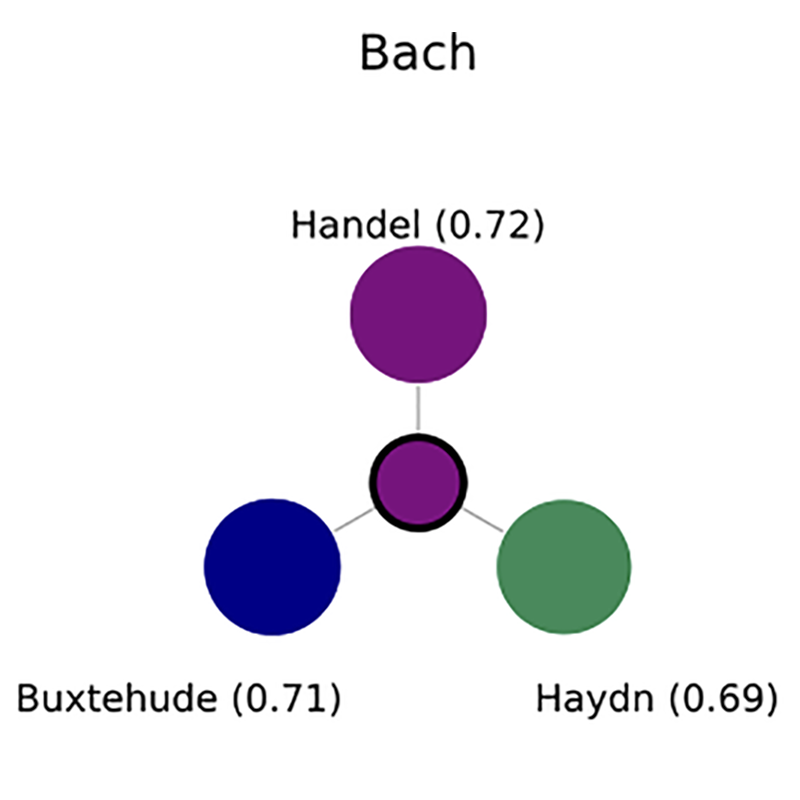
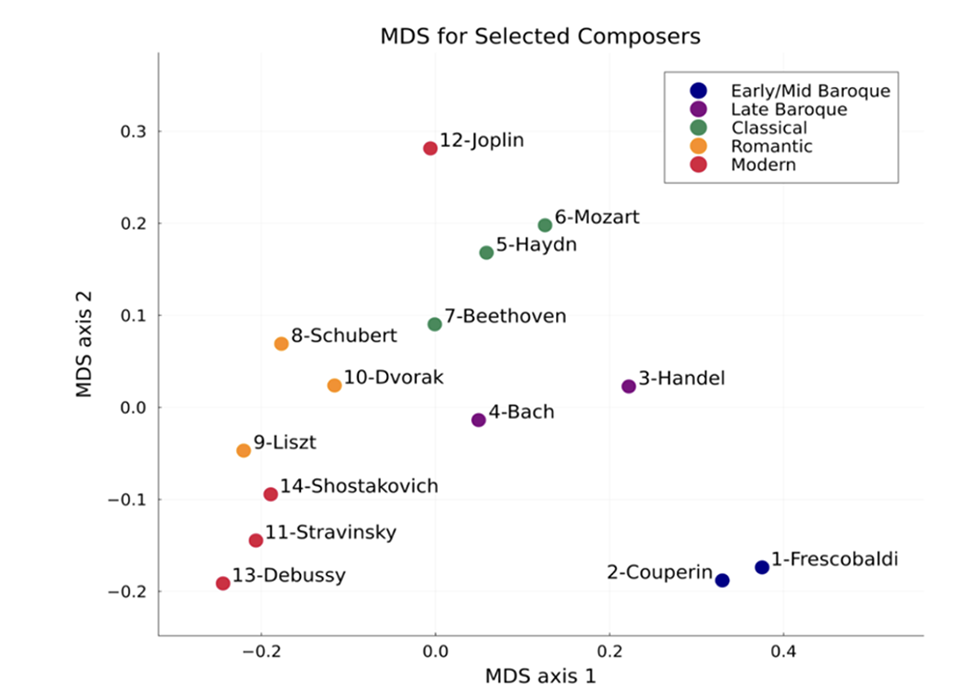
In some cases, the analysis recovered relationships already well documented by music scholars. When González-Espinoza compared composers based on their patterns of harmonic transitions, for example, one of the top 3 composers closest to Bach corresponds to Buxtehude, who was a known direct influence on his work. And composers group by period if their similarities are plotted. For González-Espinoza, findings like these suggest that computational analysis can recover meaningful historical relationships — and potentially point scholars toward others worth investigating.
Practicing open research
The decisions involved in conducting the analysis — how to structure data, select tools, and document methods — also shaped how González-Espinoza chose to share the research. As CMU’s Research Data Services Librarian, he helps researchers manage data and code throughout their projects. In his own research, he applied many of the same practices he recommends to others.
González-Espinoza conducted much of the analysis using Julia, an open-source programming language designed for scientific computing, and made the code associated with the study available through GitHub. His experience with Julia also informs his professional work: he co-authored a Data Curation Network primer that provides guidance for curators reviewing research code written in the language.
Next, he deposited his underlying research data in KiltHub, CMU’s institutional repository. Sharing the data alongside the code allows other researchers to examine how the findings were produced, reuse the materials and methods where appropriate, and pursue questions beyond those addressed by the original study. The openness extends to the publication process itself: PLOS ONE also makes the study’s peer-review history publicly available.
For González-Espinoza, this kind of access can broaden who is able to engage with research. People at institutions with fewer resources — and those outside academia — can access the materials and investigate questions independently. Openness can also provide greater transparency into the research process by allowing others to see the evidence and methods behind published conclusions.
“When more people have access, they can see the data, work with it, and explore their own questions,” González-Espinoza said. “That creates opportunities for people who may not have the resources of a research institution to engage with the work and even conduct their own research. I find that possibility incredible.”
Building infrastructure for open scholarship
Individual researchers can choose to share their work, but making open scholarship practical also depends on systems that address the financial, technical, and logistical barriers to doing so. At Carnegie Mellon, the University Libraries has developed infrastructure to support open research at multiple points in the research lifecycle, including open access publishing agreements, research data services, and KiltHub.
González-Espinoza experienced that support as an author when his study was accepted by PLOS ONE. The publisher recognized his Carnegie Mellon affiliation and the University’s participation in a PLOS open access publishing agreement. Through the agreement, eligible CMU corresponding authors can publish in PLOS journals without paying an article processing charge. González-Espinoza did not have to apply separately for funding or contact the Libraries to arrange payment; the system was already in place.
KiltHub addresses a different challenge: ensuring that research outputs can remain available, discoverable, and citable beyond the publication itself. The dataset González-Espinoza deposited there has its own digital object identifier, or DOI, providing a persistent way for other researchers to find and cite it. The published paper directs readers to both the KiltHub data and the code on GitHub, connecting the findings with materials that can be examined and reused.
Open scholarship therefore involves both individual practice and institutional commitment. Researchers make decisions about how their work will be documented and shared; infrastructure can make those decisions easier to implement and remove barriers that might otherwise limit access. In his research and professional work as a librarian, González-Espinoza is in favor of both.
“I do think open knowledge is the best way of sharing knowledge,” González-Espinoza said. “Throughout my career, I’ve made an effort to publish my work openly and make the data and code behind it available whenever possible. It’s important to me to put into practice the same principles I help other researchers navigate every day.”
His latest study puts that principle into practice, contributing new findings while making the research behind them available for others to examine, reuse, and take in directions its original authors may not have anticipated.