
by Sarah Bender
From First-Year Writing support to workshops and consultations, the Libraries delivers instruction across campus in a variety of ways. In the University Archives, Collections Archivist Emily Davis, Community Collections Processing Archivist Crystal Johnson, and Robotics Project Lead Archivist Kathleen Donahoe have introduced students of all levels and disciplines to archival research through a variety of class sessions across CMU and the wider Pittsburgh community.
“While students unfamiliar with the Archives might initially think that our scope is limited, the truth is that CMU is known for a lot of different things, from drama to computer science, and all of that is reflected in our collections,” Davis said. “We have some really diverse collections that focus beyond the history of the administration — instead, they tell the stories of our students and faculty who have accomplished incredible things, and give students opportunities to see themselves and the issues they care about represented in the past of our institution.”

First Year Writing: An Introduction to Archives
By working with First-Year Writing courses, Davis and Johnson offer students what, for many, is their first glimpse into the Archives. Knowing these visits are introductory, archivists keep their presentation to a short 10 minutes, focusing on what an archive is and how to access them.
For classes like Politics of the Senses, and Writing About Campus Activism, the archivists pull a variety of materials based on the topic of the course for students to explore. They showcase flyers, photographs, materials related to student life, and more, and invite students to handle the items and dive into the stories they preserve.
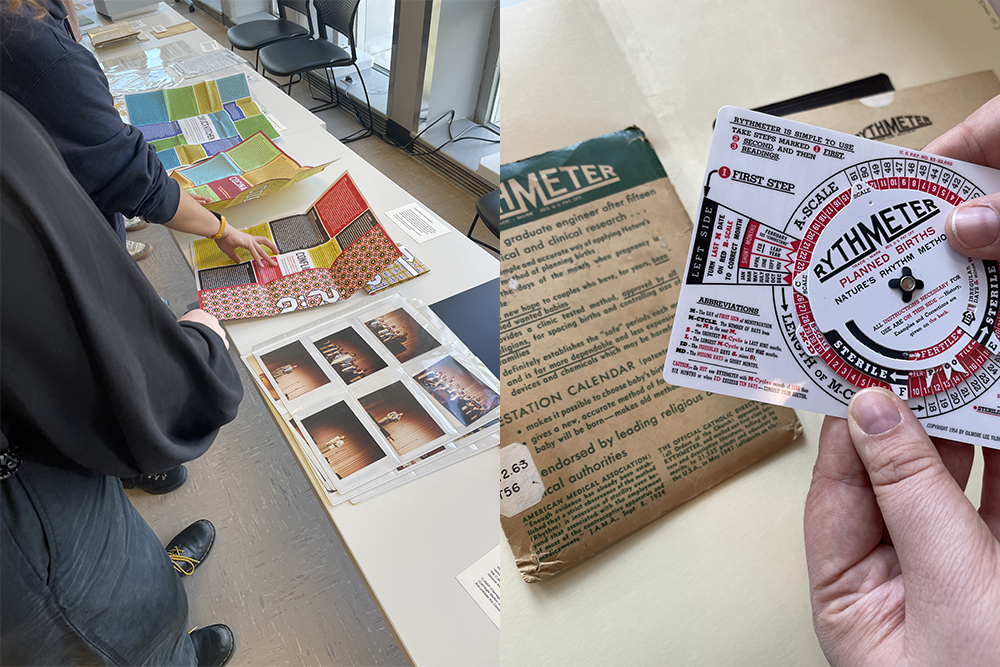
Students often take interest in an object called a “Rythmeter”, a gestation calendar patented by Gilmore Lee Tilbrook in 1945. Tilbrook was a College of Engineering alumnus who graduated in 1915, and created the family planning tool based on the rhythm method later in his career. When he donated the tool to the Libraries, it circulated, and students can view the checkout card and track its usage in the 1960s. Other materials, like a collection of records from the CMU Women’s Center that served campus from the late 1980s through the mid 2000s, have captured students’ attention as well.
Whatever catches their eye, these visits offer first-year students a chance to learn that the Archives are accessible to them throughout their time at CMU.
“These students are just starting their academic careers, and we want them to know where to go to find inspiration,” Johnson said. “The sooner we can make them feel like they belong in the Archives, and communicate that we’re here not just for serious research but for all flavors of inquiry, the more likely they are to come back to us and take advantage of all the resources we have to offer.”

Diving Deeper with Advanced Research
With more advanced classes, like a capstone research seminar in the Department of History, Davis and Johnson have the opportunity to dive even deeper into the process of archival research.
In addition to a basic introduction to what archives are and what archivists do to preserve and catalog primary sources, the archivists share with seniors the best ways to find resources in both CMU’s Archives, the Digital Collections, and collections held in other archives as well. Archivists also highlight a variety of collections from the Archives, covering many different subjects and disciplines.
After learning more about what the Archives has to offer, some students choose a topic for their capstone project related to CMU in some way. These students then return to the Archives throughout the next semester, researching their topic more in depth.
2025 Dietrich College graduate Nicholas Marshall chose to research the CMU Catholic Newman Club, a social, religious, and service organization that has existed on campus for decades. Marshall collected new materials relating to the club as part of a year-long archiving project by the 2024-2025 Libraries Student Advisory Council, and used these materials and more to investigate changes in Catholicism impacting and led by students.
“What I found was a local group of students and priests who were changing Catholic rituals faster than Rome,” Marshall said. “That same group was involved in interfaith events, international lecture series, and even ran a student zine (Dialog). And the Newman Club was, and is, just one of many many groups on campus.
“I'm very grateful for Emily bringing the Archives to my class,” he added. “Without the Archives, my world would be a whole lot smaller.”
Other students have looked at materials that document the history of student humor magazines and other publications on campus, such as The Puppet, The Scottie/The Scot/Great Scot, readme, and The Weekly Slant. The Carnegie Mellon University Student Publications Collection contains issues of these publications and more, from as early as 1914 through the present day.
“By working with these more advanced researchers who have started to think about their work in the context of the larger story, we have the ability to encourage students to engage with critical cultural moments of the past, and to explore how these points have shaped the institution we know today,” Davis explained. “This kind of research is an important part of our mission, and we’re excited to give students the tools they need to find and analyze primary sources needed for their research.”
High School Engagement
Woodland Hills High School Library Media Specialist Kevin McGuire was familiar with CMU’s Archives because it holds the papers of novelist Thomas Bell — McGuire is a scholar of Bell’s writing, and has worked with the Pennsylvania Historical and Museum Commission to organize a historical marker in honor of his work. In 2024, he reached out to Davis and Donahoe to introduce his high school students to the collection.
“Out of This Furnace,” Bell’s 1941 novel about immigration, industrialization, and unions, is set in Braddock where several of Woodland Hills’ schools are located. In fact, the novel is still being taught in schools today. When McGuire brought his students to the Archives, Davis and Donahoe shared materials like early drafts and hand-written notes by Bell and his extended family, along with personal diaries, photographs, and more.
“I can’t say enough good things about Emily and Kathleen, who were able to really connect with the students and explain what they do and why it’s such an important service,” McGuire said. “These primary documents like letters and journals humanize the figures they’re learning about. Thomas Bell wasn’t just someone who lived in their neighborhood, someone who wrote a book — he was somebody who lived a life, who had family, who cared about certain ideals. He was a whole person, who they can meet through these resources.”
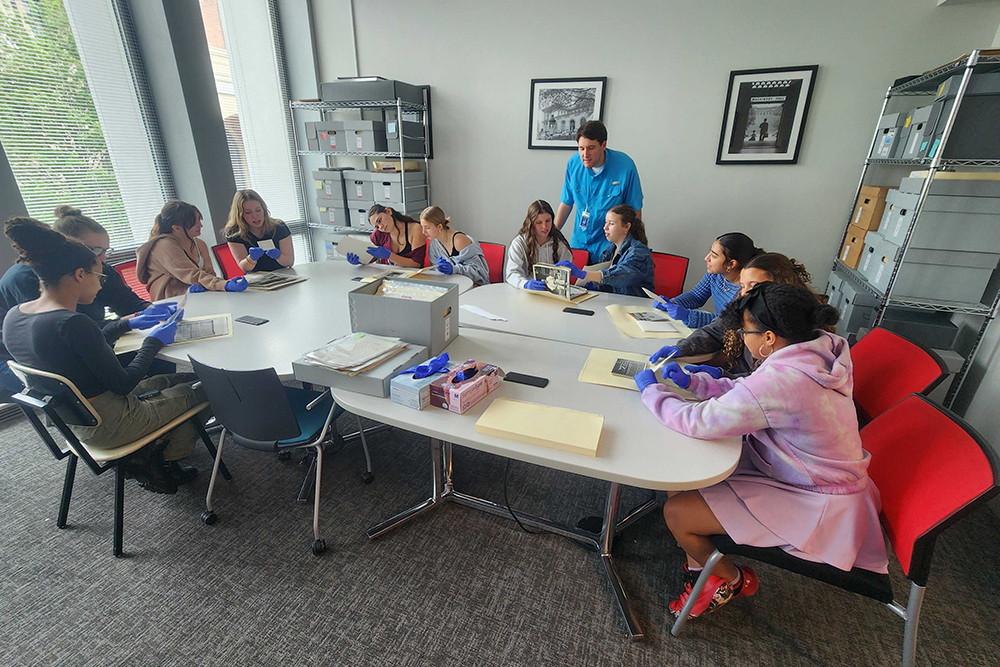
It’s also a chance for students to interact with black and white photos, negatives, and handwritten documents — some of them for the first time. “This generation is less exposed to these kinds of physical materials when so much communication is digital, so it was eye opening for them,” McGuire added. “When we were handling old photographs, the students got to put on gloves to protect the prints from oils. It’s a great opportunity to show them that there’s more to this than just old stuff sitting in a box somewhere — it’s an active space where people come to research, and where anyone can find answers to a wide variety of questions.”
City Charter High School juniors and seniors have also become engaged with the Archives, through the Leadership, Excellence, Access, and Persistence (LEAP) program — an educational program through Dietrich College and the College of Fine Arts that uses storytelling to empower under-resourced high school students to become agents of social change. Each year, Davis and Donahoe partner with LEAP to introduce students to archives and how their voices can be represented in the Archives.
High school juniors each create a zine page reflecting their experience as a student involved in LEAP, which is then added to the Archives to record the history of the program and the students who were involved. Seniors explore examples of when past students tried to bring about change on campus, analyzing primary and secondary sources like newspapers, photographs, and firsthand accounts for moments where young adults helped shape the narrative of the institution.
“These opportunities to engage with both high school and undergraduate students alike really reinforce the idea that the Archives is for everyone,” Johnson said. “No matter the discipline or level of expertise, we’d love to have new classes come in, learn about what we do, and see what resonates with your community.”
“My advice to current students: bring your questions to Thursday drop-in hours,” Marshall added. “Take a break from making the Next Big Thing and wonder about where the Last Big Thing came from. There's a relevant story in the CMU Archives, and it will make your work so much more worthwhile.”
To collaborate with the Archives on a class or other opportunity during an upcoming semester, reach out to Davis or Johnson directly.