
By Sarah Bender
Artificial intelligence can help students complete assignments, researchers write code, and scholars explore new ideas faster than ever before. But as AI takes on more of that work, what happens to the learning, critical thinking, and judgment that make it meaningful?
Students, staff, and faculty alike explored these and similar questions throughout Carnegie Mellon University Libraries' AI Fluency Week, held Oct. 26–30. Through faculty discussions and hands-on workshops, the weeklong series brought together students, faculty, and researchers to explore how to use AI thoughtfully and responsibly. More than 80 attendees joined two interdisciplinary faculty panels examining AI's role in the classroom and across the research process, raising questions about learning, accountability, and human expertise.
Building on the award-winning AI²@CMU-Q initiative developed by the Carnegie Mellon University in Qatar Library, AI Fluency Week also offered practical instruction in AI-supported research tools, prompt engineering, text mining, and AI-assisted coding.
Rethinking AI in the Classroom
Should students use AI to complete coursework? Should faculty incorporate it directly into assignments? And when does using AI interfere with the learning process itself?
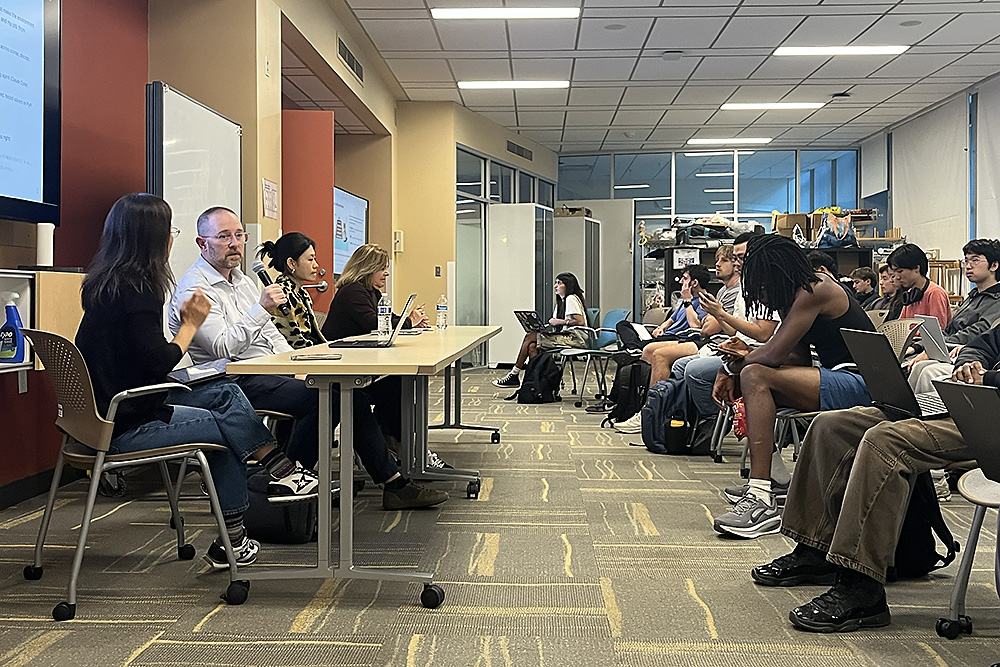
These questions were at the center of "Built-In or Banned? CMU Faculty on AI in the Classroom.” The panel, attended by more than 40, featured Gang Liu, teaching professor of Chinese studies and director of undergraduate studies in Languages, Cultures & Applied Linguistics; Fethiye Ozis, associate teaching professor of civil and environmental engineering; and Anne Kohlbrenner and Mike Taylor, assistant teaching professors in the Computer Science Department.
The discussion explored how faculty are approaching AI in teaching and learning, as well as how those decisions affect students. Participants raised questions about unequal access to powerful subscription-based AI tools, instructors' own use of AI to develop coursework, and whether expectations for student workloads are changing as AI makes some tasks easier. Students also expressed concerns about losing opportunities for collaboration and problem-solving when AI takes on work they would otherwise do themselves.
The panelists approached those challenges from different disciplinary perspectives. Kohlbrenner emphasized the importance of productive struggle in learning, while Ozis encouraged students to use AI to enhance their thinking rather than replace it. Liu stressed that developing the ability to ask meaningful questions remains more valuable than simply receiving answers, and Taylor encouraged students to think critically about the technological future they want to help shape.
The discussion highlighted a challenge facing educators and students: deciding how (and if) to incorporate AI into coursework without compromising the learning process itself. The panelists' perspectives suggested that the most important consideration isn't simply whether students use AI, but what they gain — or potentially lose — by doing so.
Keeping Researchers in Control
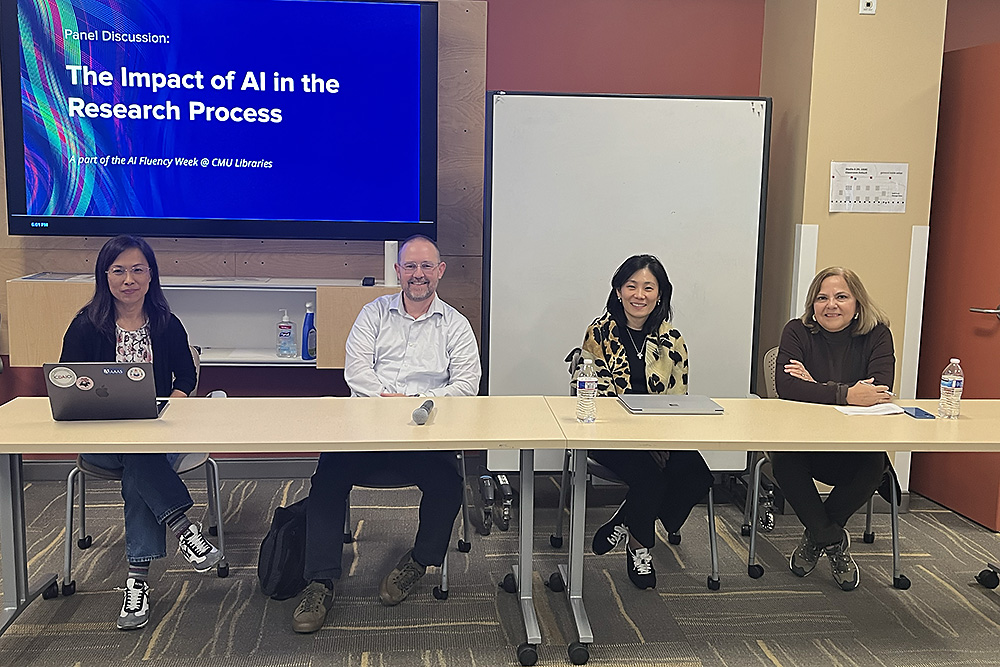
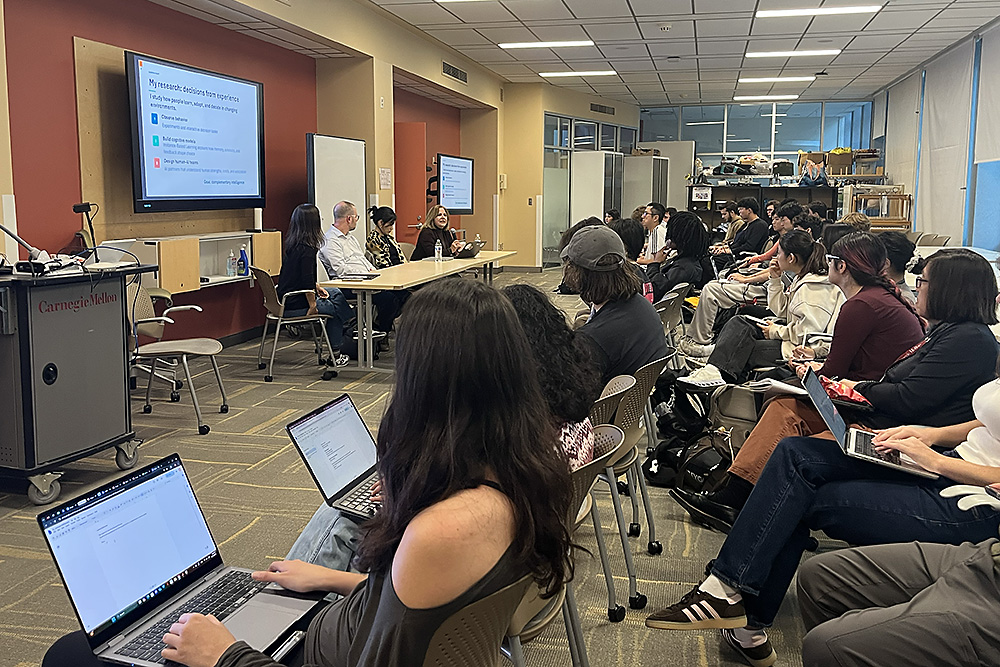
Many of the same questions emerged during "The Impact of AI in the Research Process," which welcomed more than 40 attendees.
The panel brought together Cleotilde (Coty) Gonzalez, professor of social and decision sciences; Haeyoung Kim, assistant professor in the School of Design; and John Kitchin, the John E. Swearingen Professor of Chemical Engineering. Drawing on research spanning decision-making, creative practice, and chemistry, the panelists explored how generative AI is becoming part of scholarly workflows — both the ways it can help researchers, and potential risks.
"AI can help researchers write code, explore new ideas, and tackle projects that previously seemed out of reach," Kitchin said. "But researchers are still responsible for every number, line of code, and citation. As these tools make it easier to produce results, knowing how to test and validate those results becomes even more important."
The discussion also emphasized the importance of documenting AI's role in research, protecting sensitive information and maintaining accountability for scholarly conclusions.
"AI fluency means knowing when to use AI, how to check its output, and when to set it aside," Gonzalez said. "Researchers need to keep their research questions in control, treat AI-generated ideas as possibilities rather than evidence, and verify consequential findings against original sources."
The panelists' advice underscored a central responsibility for researchers using AI: they need to maintain the ability to verify results, recognize limitations, and account for the technology's contributions to their work.
Putting AI Fluency Into Practice
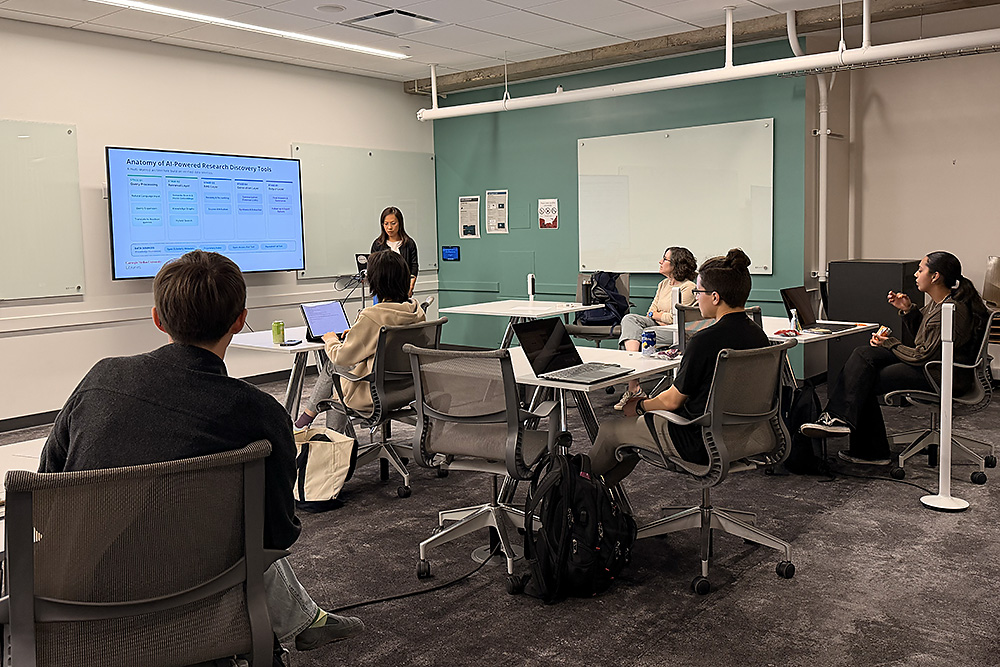
Alongside the faculty discussions, Libraries workshops gave participants opportunities to develop practical skills for working with AI in research and creative projects.
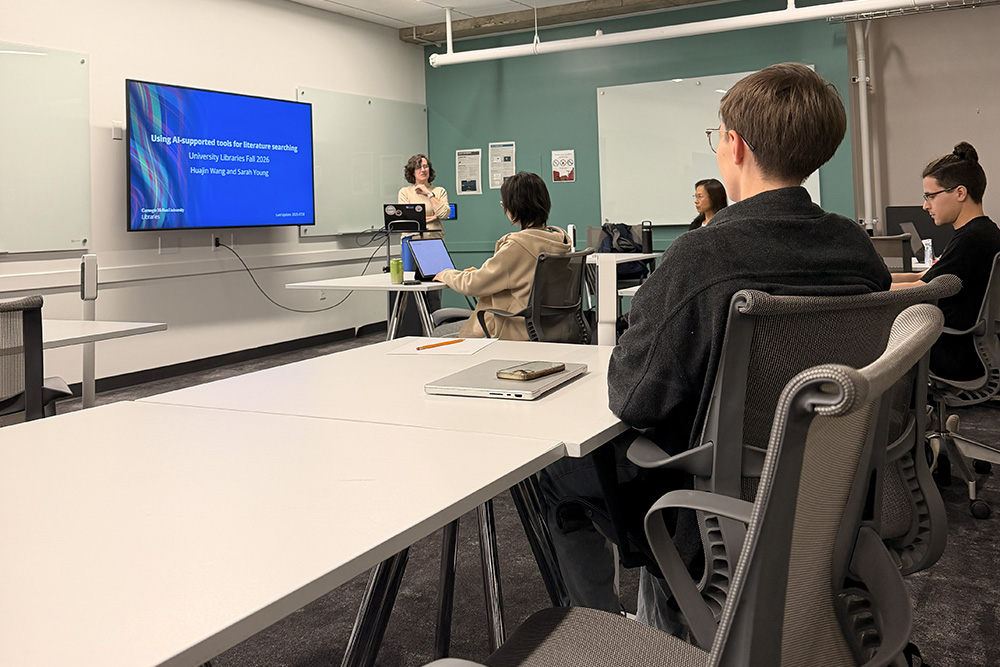
In "Using AI-Supported Tools for Literature Searching," participants explored specialized research tools including Consensus, Keenious, Scite.ai, and Scopus AI, learning how these products can help identify scholarly literature, trace citations and uncover connections among studies. "Text Mining the Scholarly Literature" introduced methods for gathering and analyzing research publications using scholarly APIs, while addressing challenges involving full-text access and licensing restrictions.
Other workshops focused on using AI effectively in project development. "Preparing to (Vibe) Code" emphasized the importance of defining a project's scope, organizing tasks and establishing requirements before using generative AI to write code. "Introduction to Prompt Engineering" introduced techniques for communicating more clearly with AI systems and critically evaluating their responses.
Across the sessions, the emphasis extended beyond learning to operate individual products. Participants encountered approaches to planning, evaluating information, and checking AI-generated results that can remain useful as technologies evolve.
"AI fluency isn't just about knowing how to use a particular tool," said Nicky Agate, associate dean for academic engagement at the Libraries. "It's about developing the judgment to understand when AI can help and when it is detrimental to your learning, how to gain enough disciplinary knowledge to evaluate what it produces, and recognizing a thoughtful human approach is preferable — even if it seems like more upfront work. By bringing faculty and students together for these conversations and hands-on workshops, the Libraries can help people build skills they'll carry into their coursework, research and future careers."
For students and researchers looking to continue building their skills, the Libraries offers year-round support through its AI in Research program, which provides guidance on evaluating AI-powered research tools, training, and consultations. The Libraries' AI Literacy resources provide additional opportunities for the CMU community to develop the knowledge and critical thinking skills needed to use AI effectively and responsibly, and Libraries faculty are offering a one-unit micro, “AI Fluency Fundamentals, Applications, and Ethics,” this coming spring.