From finding aids to movie nights, Josie Karkkainen expands access to the Architecture Archives
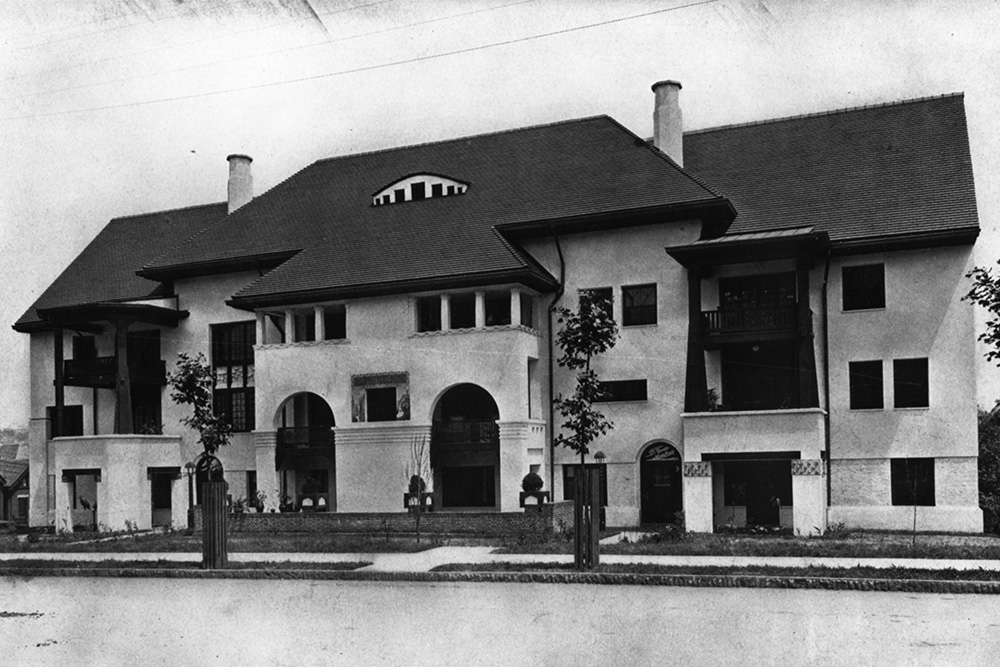
Pittsburgh architect Frederick G. Scheibler Jr. drew inspiration from the natural world, incorporating flowers, birds, and even mushrooms into buildings that stood apart from the more conventional architecture of the early 20th century. Now, more than a century later, the extensive collection documenting his work at CMU is becoming easier for researchers and curious Pittsburghers alike to discover.
University of Pittsburgh graduate student Josie Karkkainen has spent much of her time with the CMU Architecture Archives making the Frederick G. Scheibler Jr. Collection more accessible through ArchivesSpace, the open-source archival information management system that powers the University Archives’ online finding aids.
Karkkainen joined the Architecture Archives in February through Pitt’s School of Computing and Information MLIS Partners Program, which gives Master of Library and Information Science (MLIS) students an opportunity to gain hands-on professional experience at a host institution. Before pursuing her MLIS, Karkkainen worked as a legal assistant in litigation firms, eventually seeing information science as a way to combine her interests in information, data, and the arts and humanities with community-oriented work. She later worked as a metadata contractor describing historic Pittsburgh photographs from around 1920 held by Carnegie Library of Pittsburgh, an experience that introduced her to the city’s architectural history.
At Carnegie Mellon, that interest led her to one of the Architecture Archives’ foundational collections. Scheibler was an influential Pittsburgh architect whose work drew from progressive European architectural movements, including Art Nouveau and the Arts and Crafts Movement. The collection documenting his career encompasses approximately 100 projects and provides a particularly rich record of his residential architecture.
Karkkainen drew on existing scholarship and collection materials as she wrote and revised descriptive notes, updated biographical information, and developed the collection’s new finding aid. She had a model close at hand: the finding aid for the Peter Berndtson and Cornelia Brierly Collection, migrated to ArchivesSpace through the work of the Architecture Archives’ previous Pitt MLIS partner, Nick Gittins. That project provided a hierarchy that translated well to the Scheibler collection.
The transition preserves the detailed information already contained in the Architecture Archives’ legacy database while making it easier to search. Folder descriptions can identify whether materials include blueprints or drawings executed in ink on linen, for example. Once that information is in ArchivesSpace, researchers can search those terms across collections.
“There’s a lot of really rich information in the legacy database,” Karkkainen said. “It's nice to have translated that information into a more findable format.”
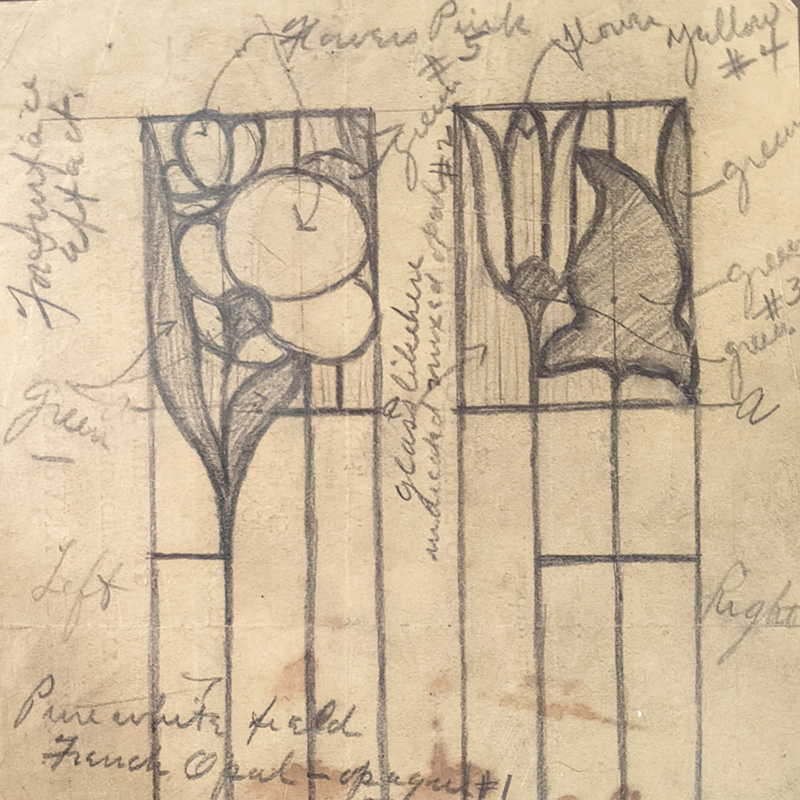 Working through the collection also highlighted for Karkkainen the thought Scheibler gave to the experience of living in a space — from sources of light and ornamentation to the relationship between a building and the natural world. While Pittsburgh architecture may bring to mind skyscrapers, churches, or other monumental structures, the collection demonstrates the creativity found in the city’s residences as well.
Scheibler frequently incorporated motifs from nature into his designs. The Harter House, sometimes called the “Mushroom House,” features dramatic curved roof forms reminiscent of mushroom caps. At Old Heidelberg, an apartment complex on Braddock Avenue that remains in use today, decorative plaster mushrooms and stained art glass reflect the same influence. Even in his more economical “group cottages,” Scheibler found ways to introduce variety and character through materials, forms, and ornamentation.
Karkkainen’s work in the Architecture Archives extends beyond the Scheibler collection. Working with Arts and Humanities Librarian and Manager of the Architecture Archives Lynn Kawaratani, she has helped develop public programming, revise web content, collect and implement user feedback, and explore new ways of introducing students and other visitors to archival materials.
This fall, the Architecture Archives is planning open hours that will allow students to stop in and view selected materials without an appointment. Then, on Oct. 8, Kawaratani and Karkkainen will host a movie night featuring original drawings of Pittsburgh’s former Civic Arena alongside a screening of “Sudden Death,” the 1995 action film shot in and around the arena. “Bad Movies and Blueprints” will include free snacks, and will begin at 6 p.m. in Hunt Library 308.
For Karkkainen, these projects share a goal with her work in ArchivesSpace: removing barriers between archival collections and the people who might find something meaningful in them.
“I think it’s important for people to know that even curiosity alone is a perfectly good reason to come to an archive,” she said. “There’s something really intimate about connecting with the lives and stories that are being preserved. You don’t know what you don’t know, and being exposed to such a wide variety of materials and information has the opportunity to spark an interest or teach you something.” That idea has become central to Karkkainen’s work and studies: archives should not only preserve information, but make it possible for people to encounter and explore it.
“Archives belong to everyone,” she said. “We’re not gatekeepers; we’re caretakers. The information in our holdings belongs to everyone, and if there are barriers preventing people from understanding or exploring their curiosities, it’s our responsibility to break apart those barriers and reach people.” The Architecture Archives has given Karkkainen a place to put that philosophy into practice — whether making century-old architectural records easier to find online or creating new reasons for students to walk through the archives’ doors.
“I don’t know if there’s a better-suited environment where I could explore my research interest in bringing archives to the community and making them more accessible and discoverable,” Karkkainen said. “It’s been a pure joy.”
The Frederick G. Scheibler Jr. Collection is one of the Architecture Archives’ collections documenting thousands of projects and the work of hundreds of designers across Carnegie Mellon, Pittsburgh, and the surrounding region. The collections are available to Carnegie Mellon students and faculty, outside scholars, and members of the public.