by Sarah Bender
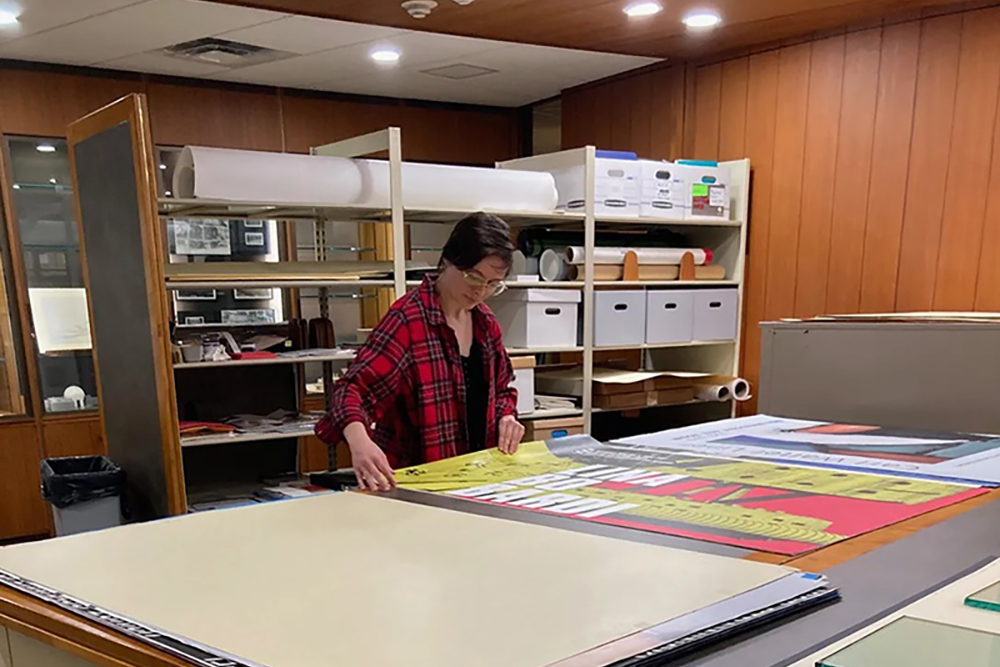
The CMU Architecture Archives’ collections document thousands of architectural projects and the work of hundreds of designers, making it a valuable resource for Carnegie Mellon, Pittsburgh, and the region. Through the University of Pittsburgh’s School of Computing and Information MLIS Partners Program, the Architecture Archives welcomes a Master of Library and Information Science student each year to work closely with Arts and Humanities Librarian and Manager of the Architecture Archives Lynn Kawaratani, and experience the collections firsthand.
This year’s partner is Pitt graduate student Josie Karkkainen, who began working with the Architecture Archives in February. We asked Josie a few questions to learn more about her path and her contributions to the Architecture Archives this semester.
Q: Tell us a bit about your journey so far. How did you end up pursuing a career in information science?
A: My previous career was as a legal assistant in litigation firms. I wanted to go back to school for a while and decided that an MLIS was kind of the perfect crossover of my interests. It’s a community-oriented path that also let me sharpen my skills in information science. Some of my favorite parts of the program have been learning data analysis with Python and R, and the exploring crossover of data and the arts and humanities.
Q: What were you most excited about at the start of your role at CMU? Did you have any goals — for example, things you wanted to learn, projects you wanted to pursue, or items in the collection you wanted to engage with?
A: Creating the finding aid for the Scheibler collection has been very exciting to work on. I’m thrilled to have the opportunity to make such unique and extensive materials more discoverable for people.
Q: How does working directly with collections in the Architecture Archives complement your studies at Pitt?
A: Working at the CMUAA has given me the opportunity to observe what barriers users may encounter that keep them from either using the archives, or from understanding how to use it. Finding ways for archives to break out of their silo and meet people where they’re at is something we’ve talked a lot about in my classes. Because archivists aren’t gatekeepers, just caretakers, and our collections exist to be used.
So, I’ve been able to design ways to make the archives more accessible through public programming that brings the archives to the students, revising our webpage for clarity and ease of access, collecting and implementing user data from survey results, and of course putting more of our materials online, such as through the Scheibler finding aid.
We have an ongoing project where we are creating informational rack cards for projects in our collections. The thought is to provide research entry points to anyone visiting the archives, and if you see cards that interest you, you can just grab a bunch of them to learn more about what you can find in the archives. For example, we received feedback that students were interested in learning more about the history of CMU’s campus, and so we’ve created cards on Henry Hornbostle, who designed the campus plan for CMU.
Q: What’s your favorite item from the collections that you’ve found or worked with so far?
A:The Civic Arena drawings, which are going to be on display at our upcoming movie night on September 17. We’ll be showing Sudden Death, a 1995 action movie filmed in the Civic Arena and using the architectural drawings as teaching tools.
Q: What’s one thing you wish more people knew about the Architecture Archives?
A: That curiosity alone is a good enough reason to come to the archives. We are planning open hours for students in the Fall where you can come and view materials without an appointment. Come to our movie night in September, and swing by our open hours!