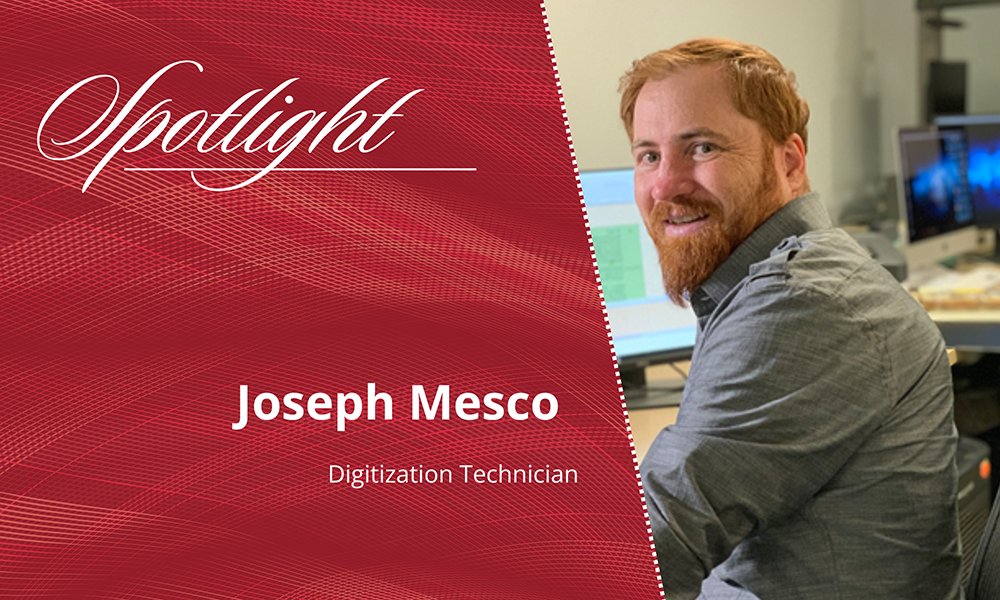
At the University Libraries, faculty and staff bring diverse backgrounds and interests to their roles, elevating the Libraries’ culture of interdisciplinary collaboration and lifelong learning and curiosity. We asked Digitization Technician Joseph Mesco a few questions about his work, to find out more about the inspiration behind his contributions to the campus community.
Q: In your own words, what is a quick overview of your role at the Libraries?
A: I work as a digitization technician focusing on rare and unique materials, including rare books, architectural drawings, archival collections, and three-dimensional objects. My work involves high-resolution imaging, digital preservation workflows, and 3D photogrammetry to produce accurate and accessible digital surrogates. Through this work, I help expand access to fragile or restricted materials for students, researchers, professors, historians, and the public, while contributing to the preservation of cultural heritage through stable digital records. I also connect traditional archival practices with emerging 3D and computational imaging technologies to improve discovery and access.
Q: Talk a little about the work you’re most passionate about. Why have you chosen to pursue this work within a library setting?
A: I’ve always felt a strong pull toward the creative and technical side of digital imaging, even if no one in my family saw that coming — least of all my mom, who worked in a library when she was younger and was convinced I’d choose a completely different path. My interest grew out of years spent experimenting with Photoshop, editing videos, and running my own YouTube channel, where I learned how to shape stories visually and solve problems on the fly. I’m also an avid gamer with a growing collection of vintage games and consoles, which has become my own little personal archive. That mix of old and new media has shaped how I think about preserving and experiencing digital and audiovisual content. Working in a library lets me bring all of that creative energy into a mission‑driven environment where the work has real cultural impact. I love the combination of hands‑on problem‑solving, visual craftsmanship, and the responsibility of helping preserve materials that might otherwise disappear. Knowing that the work I do helps students, scholars, and the public access rare and unique materials gives it a sense of purpose that means a lot to me.
Q: Share an experience or skillset that people might not expect a librarian/library worker to have. How is it a game changer for the work you do at CMU?
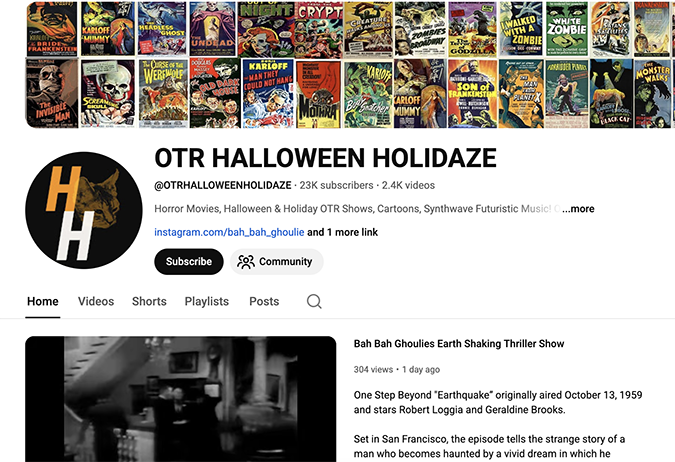 A: One skill people don’t usually expect from me as a library worker is the creative background I bring from running my own horror‑themed YouTube channel with more than 23,000 subscribers. Creating those videos — editing footage, designing images, experimenting with effects, and using AI tools — has given me a strong sense of visual storytelling and technical problem‑solving. I’ve also built and cared for a large personal archive of vintage video games, consoles, and old gaming advertisements, which taught me how to organize and preserve media in a way that feels very close to archival work. Together, those experiences make me approach digitization with both a creator’s eye and a collector’s care, which helps me produce digital surrogates that are not only accurate but engaging and meaningful to the people who use them.
Q: The Libraries serves as a neutral convening space to bring different areas of campus together. How do you value collaboration in your work? Can you give us an example of a recent collaboration that has helped a project reach new heights?
A: Collaboration is a key part of my work in the Digitization Lab. The Libraries serves as a neutral space that brings together students, faculty, researchers, and community partners, and our projects often depend on that kind of cooperation. I regularly work with students, researchers, and campus departments to help digitize materials that support their projects and make them more accessible.
For example, we collaborated with University Archives and the Robotics Institute on a project to digitize six binders of color negatives. By working closely with their team, we were able to ensure the materials were digitized at high quality and organized in a way that made them easier to use for research and documentation.
We have also partnered Architecture Archives and organizations outside the university, such as the Trolley Museum and researchers with the Knoxville and Duquesne Inclines, to digitize oversized architectural drawings and blueprints. These collaborations allowed us to use our large-format scanning capabilities to preserve materials that might otherwise be difficult to access. Making these documents available digitally has opened new opportunities for researchers both on and off campus.
Another ongoing collaboration is with our Architecture Archives, where we are digitizing materials from the Hornbostel Collection. This collection includes drawings, blueprints, and journals from Henry Hornbostel, one of the primary architects responsible for many of the buildings on campus. Working together ensures these historically significant materials are preserved and accessible for future study.
Through these kinds of partnerships, collaboration not only improves the quality of the work we produce but also helps expand access to important historical and research materials.
Q: What’s an area that you want to innovate and push boundaries in? Why is it exciting to you?
A: One area where I’m excited to innovate and push boundaries is in the use of emerging technologies like AI to improve digitization workflows. With the recent advances in AI, there is a lot of potential for improving both imaging processes and OCR (Optical Character Recognition) output. These tools could help us refine how we process images, enhance quality, and make digitized materials more accurate and usable.
I’m particularly interested in how AI might help with OCR for difficult or degraded text. Many historical documents contain unusual fonts, faded ink, or handwritten elements that traditional OCR software struggles to interpret. Advances in AI could help us better recognize these challenging characters and improve the overall accuracy of the text that researchers rely on.
I’m also excited about the possibilities of expanding into 3D scanning in the future. Being able to capture three-dimensional objects in detail would allow us to preserve and share materials in new ways, giving researchers and the public more interactive access to artifacts that might otherwise be difficult to study.
Exploring these technologies is exciting to me because they have the potential to expand access, improve preservation, and open new possibilities for how people interact with digitized collections.
Q: What’s something in the Libraries that speaks to you personally? This can be a book, something in the Archives or Special Collections, a space in one of the buildings — anything you want to highlight!
A: One thing in the Libraries that really speaks to me personally is working with the Fine and Rare Books in Special Collections. Before starting my position as a digitization technician, I didn’t fully realize how vast and unique that collection is. Being able to work directly with those materials has been both surprising and exciting.
One item that has always stood out to me is a first edition of “The True Prophecies or Prognostications of Nostradamus” from 1672. Seeing and scanning a book like that really highlights the historical depth of the collection and reminds me how important it is to preserve these materials for future researchers.
I also find it exciting to be part of the Digitization Lab as we move into the new Posner Center. With the new workspace and equipment, it feels like a fresh chapter for the lab and opens up new possibilities for the kinds of projects we can take on. Being able to contribute to preserving rare materials while also helping shape the future of the digitization program is something that really motivates me.