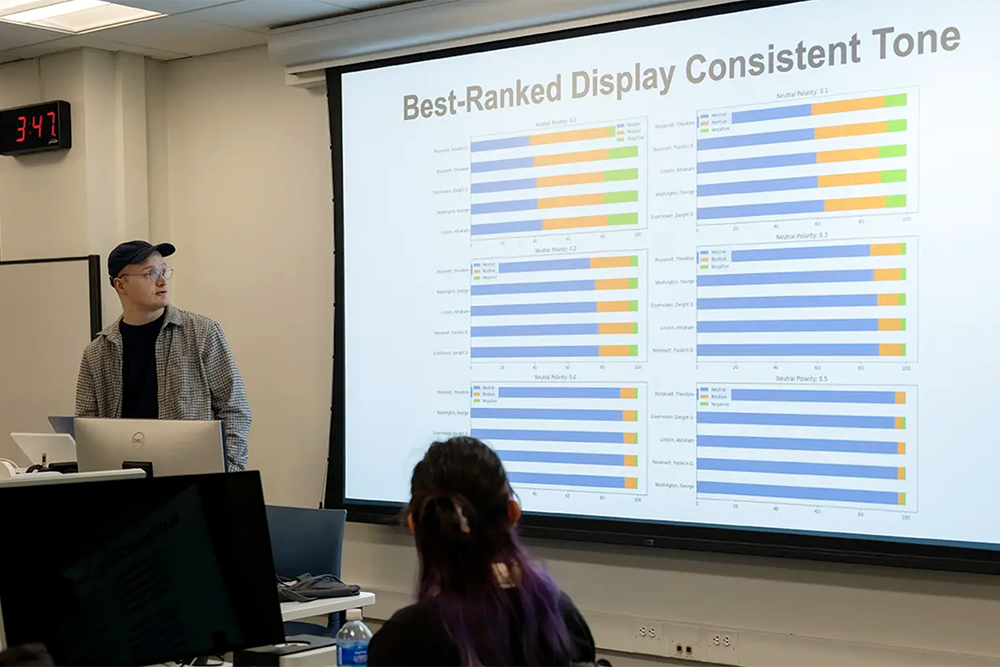
John Rose, a graduate student in the Department of English, presents a final project in the Coding for Humanists course.
Making a big bet on “computational humanities,” Carnegie Mellon University will introduce new academic programs and resources for students and researchers to blend traditional humanistic inquiry — literary interpretation, historical research and cultural critique — with computational methods like computer vision, machine learning, network analysis and data visualization.
“Carnegie Mellon University is the perfect place to lead a new era in computational humanities. We’re not replacing humanistic thinkers with computers in any sense. The humanists will remain solidly in the driver’s seat — they will pose the questions and develop the theories. We are catalyzing interdisciplinary research to empower the humanities in ways that Carnegie Mellon is uniquely capable of doing,” said Richard Scheines, Bess Family Dean of the Dietrich College of Humanities and Social Sciences. “Our faculty are already shaping this emerging field, and the world needs graduates who can think critically and work across disciplines to understand and improve the human condition.”
View the complete article on the CMU news website.